The Beach Boys have released their first new song in over two decades, "That's Why God Made The Radio". Yesterday, we posted the video preview of the song, and today, we've got the entire song for your listening pleasure! Just click below and hear the sound that has endured for half a century.
Just click the player above to hear "That's Why God Made The Radio". The full CD of new Beach Boys songs comes out June 5th, and the band is on the road now. Check yesterday's post for the complete North American tour information.
BONUS:
I found a video of the late great Dick Clark interviewing the Beach Boys during their first appearance on American Bandstand in 1964. It really shows the innocence of the Beach Boys and the talent of Dick Clark. See it here:
Today we lost a legend, the one and only Dick Clark. Perhaps the best story ever written about him was in a book called Turn It Up, American Radio Tales by Bob Shannon. If you have any interest in music and the history of radio, you will love this book, and it's available at the link above.
With the kind permission of the author, here is Bob Shannon's story about Dick Clark.
|Dick Clark: The Oldest Teenager
In 1949, after 18 years on
the air, Fred Allen’s long running network radio show was canceled. Allen
blamed television and was widely quoted at the time, when he said,
"Television is a device that permits people who haven’t anything to do to
watch people who can’t do anything.”
Allen may have been too old to get it, but Dick Clark wasn't. By the
summer of 1956, which is when Clark took over a local Philadelphia teen dance
show, he'd already been around radio and television for ten years. "I was
young, naïve and very innocent,” he says. “I didn’t know about politics or big
business and didn’t know there was a concerted effort to kill the music.” What
he did know was rock 'n' roll was
wildly popular to the youth of America, even if he didn't realize that one day
he’d have to fight for rock 'n' roll’s legitimacy before Congress, or that the
music and its presentation on television would be the foundation for his
career.
On July 9, 1956, George Koehler, General Manager of WFIL-TV in
Philadelphia, announced that Dick Clark would replace popular local DJ Bob Horn
and become the new host of the station’s afternoon TV dance show, “Bandstand.”
(Horn had originated the show in October of 1952, but after a DUI arrest in 1956,
along with allegations involving statutory rape charges, he lost the show.) In
his book, “Dick Clark’s American Bandstand,” Clark tells of being met outside
the studio that day by picketers “furiously waving their signs.” He says he
began to speak to them, by introducing himself and telling them about his new
job. He wrote that the crowd stayed silent and, not knowing what to do, he
simply said, “I’ve got to get to work now. If you want to come in, please
do.”
With only two minutes to airtime, the picketers caved and ran into the
studio. Clark says relief swept over him. "I dreamed of doing the show,”
he told me. “It was the opportunity of a lifetime.”
What it was was a ticket to ride. "When I was 13,” Clark says, “I saw a radio show
done by Garry Moore and Jimmy Durante and decided that’s what I wanted to
do.” Utica, New York, is near Rome, about 250 miles northwest of New York
City and today, among other things, it’s the home of the Boilermaker, the
largest 15-kilometer road race in the nation. In 1946, when Dick Clark was 16,
his uncle, the owner of a local newspaper, was in a race with time to get a new
radio station, WRUN, on the air, and he needed help. He turned to Clark’s
father.
Dick Clark, the father - think the two George Bushes - had been in the
cosmetic business for over a quarter of a century. But broadcasting appealed to
him and, in fact, he remained in radio until he retired. (Interestingly enough,
the Rock 'n' Roll Hall of Fame’s bio on our Dick Clark says that he was WRUN’s Sales Manager, not his
Dad. This mistake, particularly when I referenced it, almost derailed my
interview with him. You may infer, as I did, that Clark is not amused about
historical inaccuracies.) So, to set the record straight, Dick Clark didn’t
break into radio as a sales executive; instead, he got his foot in the door by
way of the mailroom. But, it wasn’t too long before he opened a mic. “I was
16,” he says, "and was on the FM station. Which, of course, nobody
listened to in those days.”
After high school, Clark raced west to Syracuse University. “I went to
study radio, but they didn’t have a course in it.” So, and this won’t surprise
you, he studied business administration, labeled radio an “extra curricular
activity,” and found time to work at a local 250 watt station, WOLF. “Prior to
the well known guys, McLendon and Storz,” says Clark, “there was a guy named
Sherm Marshall who hired kids from the college at a dollar an hour.” Clark did
a country show called “The WOLF Buckaroos” and hosted “The Sandman Serenade,”
the all night Top 40 show. One day the phone rang at
WRUN. Dick Clark, the elder, answered it.
"WRUN."
"Dick,” said the manager of WKTV Television, “I need a newscaster.
Would you mind if I hire your son?” The younger Clark had graduated from
college, returned home and agreed to work for his father. Still, he was
ambitious and, fortunately, his father was supportive. Television, they both
agreed, was the perfect next step and that WKTV was a good place to pay his
dues.
“So, I did the six and eleven 11 o’clock news and probably did it pretty
well, because I started getting job offers,” says Clark. But, did he leave for
greener pastures? No, not yet, because WKTV wouldn’t release him." The
manager of the station,” says Clark, “would call the guy offering me a job and
say, ‘You can’t take this kid away.'”
So, Dick Clay (he used an air name early on, reasoning that his father
was the Dick Clark everyone in Utica knew) stayed put at WKTV. But, he
continued to send out tapes. “Like all disc jockeys do, although I was in TV, I
said to myself, ‘You need to get into a bigger market.'” His tapes went out to
Albany/Schenectady and to stations in Philadelphia. When nothing happened, his
father made a phone call to the Station Manager at WFIL-TV. "I’ve got this
kid. Would you have somebody look at him?"
Now Clark had a shot, but he had to perform. “The way I won the audition
was unique,” he says. “They gave me a ream of copy and said, ‘OK, we’re going
to the control room and we’ll call you after you’ve had a chance to look it
over. Just read into the camera.'" For most young auditioning performers
hitting the copy cold would have caused a problem but it wasn't for Clark
because, in Utica, he'd discovered a secret. “We recorded the copy onto audio
tape and then fed the recording into my ear.That way I could spit it back at the
camera.” And he could do it while looking into the camera. In other words – eye
contact!
They called down from the booth. “Are you ready?”
“Yeah, I said,” remembers Clark. “Then I read it back to them,
absolutely verbatim. They were flabbergasted because there wasn’t a
teleprompter or cue cards. And, that’s how I got into television in Philly.”
Well, almost. In
truth, WFIL TV thought he looked too young, so they gave him a radio show
instead, and allowed him to do occasional TV fill in work. One of the shows he
subbed on was called “Bandstand.” On August 5, 1957 “American Bandstand” went
national.
“ABC gave us a seven week trial,” says Clark. Within four weeks the show
was the #1 daytime TV program in America. From a 21st Century perspective,
Bandstand, particularly the shows from the '50s, seems very old school. But, at
the time, it was cutting edge music television and over the years - 1957 to
1989 - acts that appeared on its stage include Frankie Avalon, Aerosmith, The
Animals, The Beach Boys, Chuck Berry, James Brown, Bon Jovi, The Carpenters,
Johnny Cash, The Doors, Van Morrison, Otis Redding, Run-D.M.C., Roy Rogers,
"Weird Al" Yankovic, and even Rick Dees. In 1963, after six years of
doing the show for five days a week, Clark turned it into a weekly show and a
year later, he moved its production from Philadelphia to Hollywood.
Once in California, Clark began to build a production empire that grew
to include “Where The Action Is,”
“Pyramid,” “TV Bloopers and Practical Jokes,” “The American Music Awards” and,
perhaps most famously, “Dick Clark's New Year's Rockin' Eve.” For radio, Clark
developed “The Dick Clark National Music Survey” for the Mutual Broadcasting
System (1981) and “Dick Clark's Rock, Roll and Remember” for his own company,
United Stations (1982). On December 8, 2004, Dick
Clark suffered a stroke.
Initial reports called it "minor," but a week later his
company announced that for the first time since 1972, Clark wouldn't be hosting
his New Year's Eve television show. (He did return the next year and, in recent
years, has been joined by Ryan Seacrest.) Behind the scenes Clark is still
active, though not as much as he'd like, but his businesses, including
restaurants licensed under Bandstand inspired names, continue to flourish.
Over 50 years ago, when rock 'n' roll scared the hell out of adults (and
almost anyone over 30) it was Dick Clark who stood up to promote and defend it.
While it's true that “American Bandstand” brought him glory, wealth and fame,
it's also true that he was blamed for perpetuating what many non-believers
referred to as "raw, insidious music." In 1990 Dick Clark was
inducted into the Radio Hall of Fame. This recognition - just one of dozens, if
not hundreds, of awards and accolades he's received over the years - was well
deserved.
Dick Clark's legacy comes down to one thing and it's that he brought
teens and music to television and, by doing so, redefined the entire culture at
exactly the right time.
If it weren’t for Dick Clark, things would be different.
My thanks to Bob Shannon for letting me share this great story. May Dick Clark's memory be a blessing and an inspiration.
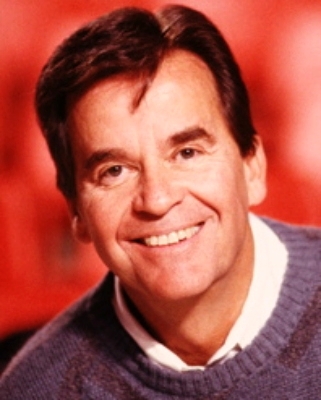
The Dick Clark you see pictured is the way I want to remember Dick Clark, not the way we've seen him the last few New Years' Eves after the stroke he suffered in 2004. To me , Dick Clark was a God, a man who was truly America's Oldest Living Teenager, and the person who brought the best music of the day into my home every day and then every Saturday on "American Bandstand".
I never met Dick Clark, but I did see him tape a few episodes of "The $10,000 Pyramid" back when I was in High School. I watched him on TV, I listened to him on the radio, and I read his book. And yes, I watched him all those New Years' Eves after his stroke with a combination of pity and respect that I could never really explain.
In tribute to Dick Clark, here's a video of the original "American Bandstand" theme and scenes from the show's early years.
Rest In Peace, Dick. You brought joy to untold millions as a host, producer, and living legend.